Jack Ruthven
Young Captain Jack · The Son of a SoldierJack Ruthven is the novel’s central figure and the human focus of its identity mystery. Raised as the adopted son of Mrs. Ruthven’s household, he must endure repeated challenges to his name and parentage while proving himself through action: he resists intimidation, organizes a twenty-three-member Home Guard, protects the Ruthven plantation, dives into the bay to save St. John Ruthven, survives captivity, and ultimately learns that Colonel Stanton is his biological father. His decisive significance lies in the contrast between unstable social labels and a remarkably stable moral character.
Identity and Early Life
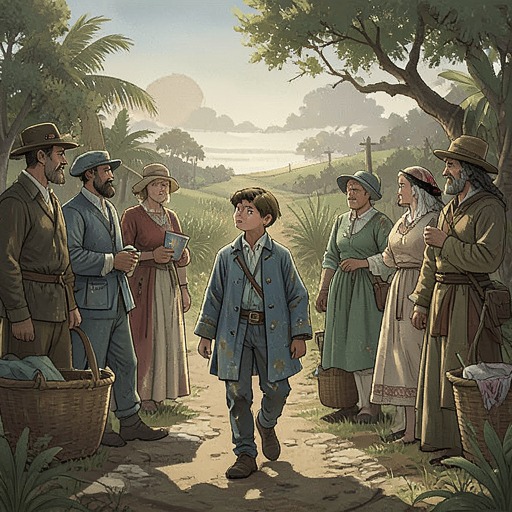
Jack lives in a large mansion set back from the river on one of the richest plantations in South Carolina. The household is governed by Mrs. Ruthven, a widow whose husband, Colonel Martin Ruthven, was killed at the Battle of Gettysburg. She has a seventeen-year-old daughter, Marion Ruthven, and the two children are described as nearly inseparable. Mrs. Ruthven’s grief and prolonged illness after her husband’s death have made her cling especially closely to them, so Jack’s place in the family is established not merely as legal dependence but through daily affection and mutual attachment.
That belonging is nevertheless vulnerable. Darcy Gilbert reports that St. John Ruthven has called Jack a nobody, has denied that he belongs to the Ruthven family, and has predicted that he will one day have to leave. The accusation fills Jack with consternation because it attacks the foundation of his self-understanding. Marion later supplies the first partial answer: when Jack was three or four, her father and mother adopted him, and he is now John Ruthven, her own brother. The revelation removes the claim that he is a natural-born Ruthven but affirms that adoption has made him a genuine member of the household. Jack’s identity therefore begins as a layered story—uncertain origin, definite adoption, and earned brotherhood.
A ring and a delicate lace handkerchief become material signs of the hidden past. Mrs. Ruthven retrieves the ring from a small jewel casket, but its marking has become so worn that neither of two jewelers can identify it. To Jack it looks like a wedding ring, and its incomplete inscription preserves the mystery rather than solving it. The object gives the identity question a physical center: names and recollections may be disputed, but the ring remains a trace waiting to be interpreted.
Courage and Wartime Action
Jack’s first defining quality is resistance to bullying. On the bridge, an impatient man demands directions to Tanner’s Mill, tugs nervously at his heavy mustache, and orders Jack out of the way. Jack refuses to be intimidated, quietly resumes fishing, and only later gives the terse answer, “Keep to the right and you'll be right.” After the rider leaves, Jack realizes that fighting at Tanner’s Mill would bring the war dangerously close to home. The episode establishes both his independence and his practical awareness: he does not mistake loud authority for legitimate authority, yet he understands the consequences of military movement around the plantation.
He has already imagined himself in uniform, speaking on several occasions of enlisting as a drummer boy. Mrs. Ruthven refuses to spare him, insisting that one member of the family has already gone, while Marion clings to him as well. Jack’s longing for the glory of a soldier’s life initially contains no thought of its hardships, but wartime responsibility soon reaches him without requiring formal enlistment. When danger threatens the plantation, he acts not for adventure alone but to protect Mrs. Ruthven and Marion.
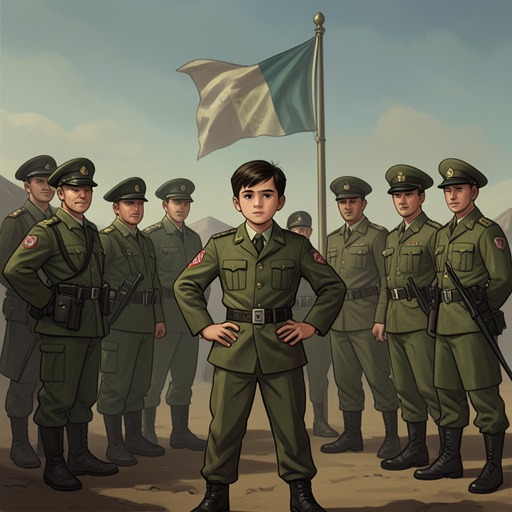
Jack organizes a Home Guard with Darcy Gilbert and Old Ben. The company consists of twenty-three boys, and Jack is its captain—“Captain Jack” to Marion. He has an old sword and a pistol, while the other boys possess pistols or guns. The improvised force is militarily modest, but its importance is moral and civic: Jack converts youthful aspiration into organized defense. He explicitly regards the plantation as private property and the women of the household as persons whom the enemy must not molest.
When Confederate soldiers bring wounded men to the mansion, Mrs. Ruthven admits them and the house becomes a field hospital. Six wounded Confederates are placed on cots in the sitting room, a young surgeon begins treatment, and Mrs. Ruthven and Marion assist. Jack’s defense of the home thus coexists with humanitarian care. The plantation is not represented only as territory to be held; it is also a refuge whose hospital function imposes obligations even amid battle.
As cavalry passes and guerrillas approach, Jack draws his boys across the lawn in front of the homestead. When Captain Sandy Barnes asks what they are doing, Jack answers that they are the guard of the house. His quiet firmness contrasts with the guerrillas’ reputation as looters who fight for plunder. The confrontation gives concrete form to his moral worth: he claims authority through responsibility, not rank, age, or force. Later, after the shooting has moved toward the mountains, he returns almost breathless and asks whether Mrs. Ruthven and Marion are safe, explaining that he has been at St. John Ruthven’s place dealing with the fire. His immediate concern is always the safety of those entrusted to him.
Rescue, Captivity, and Resistance
Jack’s courage becomes most vivid in the rescue of St. John Ruthven. When St. John sinks for the second time and Marion fears that he will drown, Jack orders attention to the boat and dives into the bay after him. He had hesitated to bring the craft closer because he feared striking St. John, but then strikes out boldly and dives again, surfacing beside the sinking young man. The rescue is an important reversal in their relationship: although St. John’s contempt has helped provoke Jack’s identity crisis, Jack does not allow resentment to govern his conduct.
The war also subjects Jack to a condition in which courage cannot simply overpower danger. He becomes a close prisoner in a small cabin high on the mountain side, his hands bound behind him to a heavy wooden stake driven into the hard mud floor. A night passes while the Confederates leave him alone, and he is left thirsty and hungry. The scene strips away his uniform, command, and domestic protection, reducing him to bodily vulnerability while preserving the question of how far his will can endure.
The guerrillas later move him and his companions to a fair-sized cave, where they tie the prisoners to jagged rocks. The outlaws make themselves comfortable by lying around, drinking, smoking, and playing cards. This contrast between their casual comfort and the prisoners’ restraints exposes the lawlessness of the captors and clarifies Jack’s situation as coercive imprisonment rather than honorable military detention. His ordeal tests not only physical endurance but also the values that have defined him in open spaces—the bridge, the bay, the lawn, and the plantation—now turned against him in a hidden mountain enclosure.
Competing Fatherhoods and Recognition
Jack’s uncertain parentage is repeatedly rewritten by competing claims. Dr. Mackey approaches him after the earlier bridge encounter and asks that the conflict be forgotten, saying that he has come on an important mission. He then declares, “Jack, I am your father!” and repeats that the astonishing news is true. The claim is powerful because it comes from an adult who presents himself as a medical man and bearer of knowledge, but it is also destabilizing: Dr. Mackey offers a biological identity that conflicts with the family identity Jack has lived.
The later revelation overturns Dr. Mackey’s assertion. Jack learns that Colonel Stanton is wounded and has disclosed a past concerning him. The decisive statement is that Jack is not Dr. Mackey’s son at all, but the colonel’s son. Jack can hardly frame the words when he realizes that he is Colonel Stanton’s child, and the claim is said to have been proved beyond doubt. The novel therefore resolves the mystery through a progression from insult, to adoption, to false biological recognition, and finally to authenticated parentage. Each version changes the apparent meaning of Jack’s life, but none erases the bonds created by the Ruthven household.
The conflict over fatherhood also separates biological descent from moral authority. Dr. Mackey can name himself as a father, but the claim does not define Jack’s conduct. Mrs. Ruthven and Marion provide the home in which he is loved and recognized; Colonel Stanton provides the biological truth that eventually explains his origin; Jack himself supplies the continuity through courage and loyalty. The narrative’s evidence chain makes identity a matter of relationships, objects, testimony, and proof rather than a simple declaration by the most forceful adult.
Growth, Ending, and Narrative Role
Jack’s trajectory follows a clear growth arc. He begins as a self-reliant plantation boy who dreams of military glory, becomes the captain of a twenty-three-member Home Guard, acts as defender of the household during battle, serves the wounded indirectly through the protection of the mansion, rescues St. John Ruthven, and endures binding and deprivation in captivity. These episodes move him from imagined soldiering to practiced responsibility. His bravery is not confined to combat; it includes judgment on the bridge, loyalty in the bay, protection of civilians, and endurance when he has no weapons or command.
His final social advancement does not invalidate his earlier foster-child status. Once the truth about Colonel Stanton is established, Jack is confirmed as the son of a soldier, but the story has already shown that he belongs to the Ruthven family through adoption and lived devotion. The later double wedding at the plantation joins Marion Ruthven to Dr. Harry Powell while Mrs. Ruthven marries the colonel, bringing the family and Jack’s biological history into a new arrangement. In contrast, St. John Ruthven’s decline is marked by continued wastefulness, the loss of the plantation, and disappearance into New Orleans and then the West.
Years later Jack enters West Point Military Academy and graduates with high honors. He goes West as an officer at a well-known fort, earns a career described as full of daring and honor, and rises rapidly to the rank of colonel, which he fills with his established bravery and loyalty. The ending converts the boy once called a nobody into a publicly honored officer without suggesting that rank created his worth. Military distinction is instead the mature institutional form of qualities already visible on the bridge and the plantation.
Jack’s narrative role is consequently double. He is the instrument through which an adventure plot moves across bridges, waterways, battlefields, hospitals, wrecks, mountains, and caves, but he is also the test by which the novel measures competing forms of value. Social rank, family name, medical authority, and biological descent repeatedly claim the power to define him; his actions repeatedly answer that character and duty cannot be reduced to any one of them. His final identity as Colonel Stanton’s son completes the mystery, while his earlier life as the Ruthvens’ adopted brother explains why the resolution is not a replacement of one family by another, but an expansion of the truth he has been living all along.